
Most wisdom teeth begin to emerge between the ages of 17 and 25, although there is no exact birthday when they suddenly appear. Some people notice their first wisdom tooth at 16, while others don’t see any movement until their late twenties. A surprising number of adults never have wisdom teeth erupt at all because they’re naturally missing them or the teeth remain buried beneath the gums.
The real answer isn’t just about age.
It’s about whether your jaw has enough space, how the teeth are positioned, and how the roots develop over time. Two people born on the same day can have completely different wisdom tooth timelines. One may have four fully erupted wisdom teeth by age 20. Another may still have impacted teeth hidden inside the jaw at 30 without realizing it.
That unpredictability is exactly why dentists usually monitor wisdom teeth with periodic X-rays rather than waiting for pain to appear. That unpredictability is exactly why dentists usually monitor wisdom teeth with periodic X-rays, as recommended by the American Association of Oral and Maxillofacial Surgeons, rather than waiting for pain to appear.
Wisdom Teeth Timeline: What Usually Happens
The development of wisdom teeth starts much earlier than most people think.
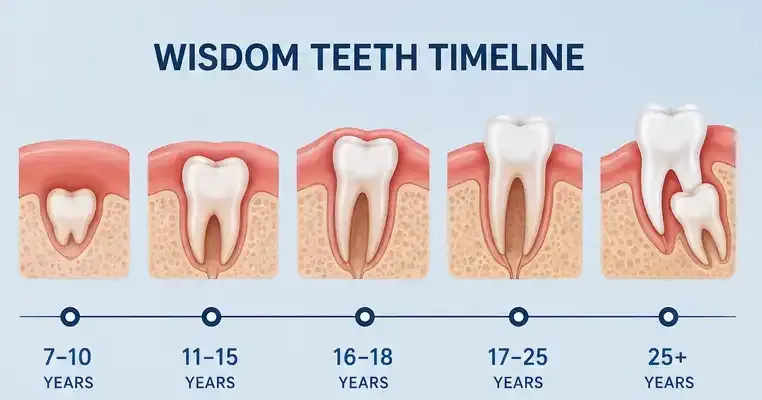
| Age | What Usually Happens |
|---|---|
| 7–10 years | Wisdom tooth buds begin forming inside the jawbone. Nothing is visible. |
| 11–15 years | Crowns continue developing while the teeth remain deep within the jaw. |
| 16–18 years | Roots begin forming. Some people notice mild pressure behind the second molars. |
| 17–25 years | Most wisdom teeth start erupting through the gums if enough room exists. |
| 25–30 years | Teeth that haven’t erupted by now are more likely to remain partially impacted or fully impacted. |
| 30+ years | Some wisdom teeth stay buried for life without causing problems, while others may develop cysts, decay, or infections years later. |
One thing many articles leave out is that eruption isn’t continuous.
A wisdom tooth may move slightly, then remain unchanged for months or even years before moving again. That’s completely normal.
First Signs of Wisdom Teeth Coming In
Many people expect severe pain.
That’s actually not the first sign most dentists notice.
Early wisdom tooth eruption often feels surprisingly subtle.
Common early signs include:
- Mild pressure behind your last molars
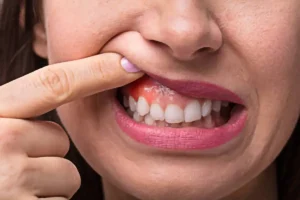
- Tender gums at the back of the mouth
- Occasional jaw stiffness after waking up
- Difficulty cleaning behind the second molars
- A small white edge of tooth appearing through the gum
- Food getting trapped farther back than usual
- Mild swelling that comes and goes
Some people also notice their bite feels “different” for a few days. This usually isn’t because wisdom teeth are pushing the rest of the teeth forward a common myth but because swollen gum tissue temporarily changes how the teeth meet.
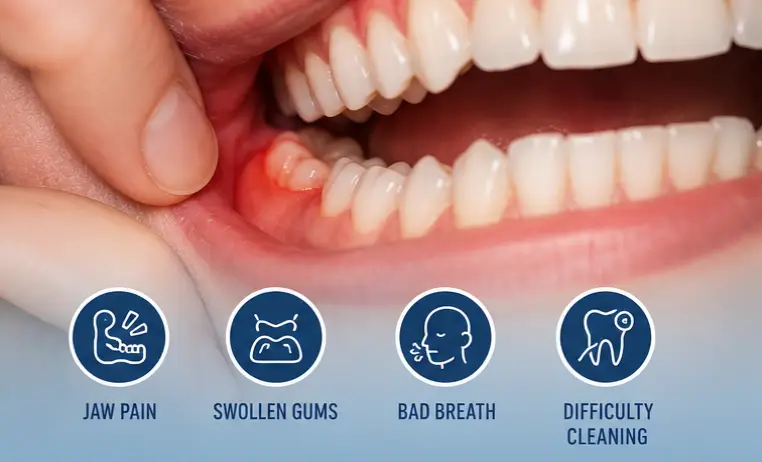
An interesting clinical observation is that symptoms often come in waves. Patients frequently report discomfort lasting three or four days followed by several symptom-free weeks.
What Age Do Wisdom Teeth Come In for Men and Women?
There isn’t a huge difference.
Women often experience wisdom tooth eruption slightly earlier because jaw and tooth development generally finishes earlier than in men.
Typical averages look like this:
Women
- Usually between 17 and 23 years
- Root development often completes earlier
- Earlier eruption may mean earlier removal if problems develop
Men
- Usually between 18 and 25 years
- Jaw growth may continue slightly longer
- Some wisdom teeth erupt successfully because of additional jaw growth
These differences are averages not rules.
Your genetics matter far more than your sex.
Why Do Wisdom Teeth Come In So Late?
This question has fascinated researchers for decades.
Earlier human ancestors had larger jaws and diets that required constant heavy chewing. Their third molars helped replace worn-out teeth and provided additional chewing power.
Today’s diet is much softer.
Our jaws have gradually become smaller through evolution, but the genetic blueprint for developing wisdom teeth hasn’t disappeared.
That’s why wisdom teeth often try to erupt into a space that no longer exists.
Researchers also believe delayed eruption is linked to the complex way permanent molars develop. Third molars are literally the last teeth to form, so naturally they’re also the last to emerge.
Tooth development continues for years after childhood, which is why wisdom teeth appear much later than the rest of the adult teeth.
How Long Do Wisdom Teeth Take to Grow?
This depends on what you mean by “grow.”
Formation starts in childhood.
Complete root development may not finish until the mid-twenties.
Actual eruption through the gums can happen over:
- Several months
- One year
- Multiple years with long pauses
- Or never
Many people think wisdom teeth appear overnight because symptoms suddenly become noticeable.
In reality, the tooth may have been moving slowly inside the jaw for years before finally reaching the surface.
Why Some Wisdom Teeth Never Come In
Several reasons explain this.
Impacted Teeth
The tooth becomes trapped against another tooth or bone.
This is the most common reason.
Not Enough Space
Modern jaws are often too small for an extra molar.
Different Tooth Position
Some wisdom teeth grow sideways, backward, or toward the cheek instead of upward.
Congenital Absence
Around 20–35% of people naturally never develop one or more wisdom teeth.
This is becoming increasingly common in many populations.
Can Wisdom Teeth Come In Without Pain?
Absolutely.
This surprises many patients.
Healthy wisdom teeth can erupt almost unnoticed if:
- Enough space exists
- They’re properly aligned
- Gum tissue stays healthy
- They’re easy to clean
Many dentists discover fully erupted wisdom teeth during routine examinations before patients even realize they have them.
Pain isn’t proof that wisdom teeth are growing.
Likewise, no pain doesn’t guarantee everything is fine.
That’s why routine dental imaging matters.
Benefits of Keeping Wisdom Teeth
Removal isn’t always necessary.
Healthy wisdom teeth can provide genuine benefits.
They Can Help With Chewing
If properly aligned, they function like any other molar.
They May Replace Lost Molars Later
A healthy wisdom tooth sometimes becomes useful if a nearby molar is lost later in life.
Avoiding Unnecessary Surgery
Every surgical procedure has risks.
If wisdom teeth are healthy, many dentists recommend monitoring rather than removing them simply because they’re present.
When Wisdom Teeth Become a Problem
Problems usually develop because they’re difficult to clean rather than because they exist.
Watch for:
- Swollen gums
- Repeated infections
- Persistent bad breath
- Food trapping
- Tooth decay
- Damage to neighboring teeth
- Gum pockets
- Cysts around impacted teeth
One small detail many people overlook is the smell.
A partially erupted wisdom tooth often traps bacteria beneath a flap of gum called an operculum. Even before pain develops, patients sometimes notice an unpleasant taste or odor.
That can be one of the earliest warning signs of infection.
Wisdom Teeth Timeline Food: What You Can Eat During Eruption
Food choices can make a noticeable difference during active eruption.
When the gums feel irritated, softer foods usually cause less discomfort.
Good options include:
- Yogurt
- Mashed potatoes
- Scrambled eggs
- Oatmeal
- Rice
- Smooth soups
- Pasta
- Cottage cheese
- Bananas
- Soft fish
Foods that often make irritated gums worse include:
- Popcorn
- Nuts
- Chips
- Crusty bread
- Sticky sweets
- Seeds
Tiny food particles are surprisingly good at hiding beneath partially erupted gums, which can trigger inflammation days later.
Gentle brushing after meals helps more than many people realize.
How to Speed Up Wisdom Teeth Recovery
If you’ve recently had wisdom teeth removed, healing can’t truly be rushed.
But you can avoid delaying it.
Helpful habits include:
- Follow your dentist’s instructions carefully.
- Keep the blood clot protected.
- Avoid smoking or vaping.
- Stay hydrated.
- Eat soft foods.
- Sleep with your head slightly elevated during the first night.
- Use saltwater rinses after the first 24 hours if advised.
- Avoid drinking through straws.
Most swelling peaks around the second or third day before gradually improving.
Recovery often feels worse before it starts feeling better.
That’s normal.
Do Wisdom Teeth Cause Crowded Teeth?
For years people believed wisdom teeth pushed every other tooth forward.
Modern research doesn’t strongly support that idea.
Crowding usually develops from several factors including natural age-related tooth movement, jaw shape, and orthodontic relapse.
Wisdom teeth may contribute in certain situations, but they aren’t considered the primary cause of lower front teeth becoming crooked.
This is one area where older advice has changed considerably.
When Should You See a Dentist?
Don’t wait for unbearable pain.
Arrange an examination if you notice:
- Swelling lasting several days
- Difficulty opening your mouth
- Fever
- Facial swelling
- Persistent bleeding
- Trouble swallowing
- Pain spreading into the ear or neck
- Repeated infections around the same tooth
Routine monitoring is often far easier than dealing with an emergency infection.
FAQ
Yes. Although less common, wisdom teeth can erupt in the thirties or even later if they slowly continue moving through the jaw.
No. Many people naturally develop fewer than four, and some never develop any at all.
No. Healthy, fully erupted wisdom teeth that can be cleaned properly often don’t need removal, a recommendation that aligns with Mayo Clinic’s guidance on wisdom teeth removal.
Mild discomfort may come and go over several days, then disappear for weeks before returning as the tooth continues erupting.
Yes. Impacted wisdom teeth sometimes remain completely buried for life without causing problems, although they should still be monitored periodically.
Why Choose Winchmore Hill Dental Practice?
Understanding when wisdom teeth come in is only part of the picture. Knowing whether your own wisdom teeth are healthy requires an examination that’s specific to your mouth, not a general timeline.
At Winchmore Hill Dental Practice, every assessment starts with understanding your symptoms, your dental history, and your X-rays rather than assuming removal is necessary. If your wisdom teeth are healthy and functional, you’ll be told that. If they’re beginning to create problems, you’ll receive clear explanations of your options, including why treatment is recommended and what recovery is likely to involve.
Patients also appreciate having continuity of care. Instead of seeing different clinicians at every visit, your dental team gets to know how your teeth have changed over time, making it easier to identify subtle developments before they become painful emergencies.
Whether you’ve started noticing pressure at the back of your mouth or you’ve been told you have impacted wisdom teeth, professional advice can prevent small issues from becoming larger ones.
Book an appointment and receive advice that’s based on your individual situation, not just your age.