
Hygiene treatments in Enfield, Southgate and North London
The job of the dental hygienist is to professionally clean your teeth, ensuring that your mouth is fresh, healthy and free from tartar. Even with the best brushing routine at home, it is impossible to stop the gradual build-up of plaque on your teeth, which continues daily. Without the regular professional removal of this tartar layer, you are at a higher risk of developing gum disease.
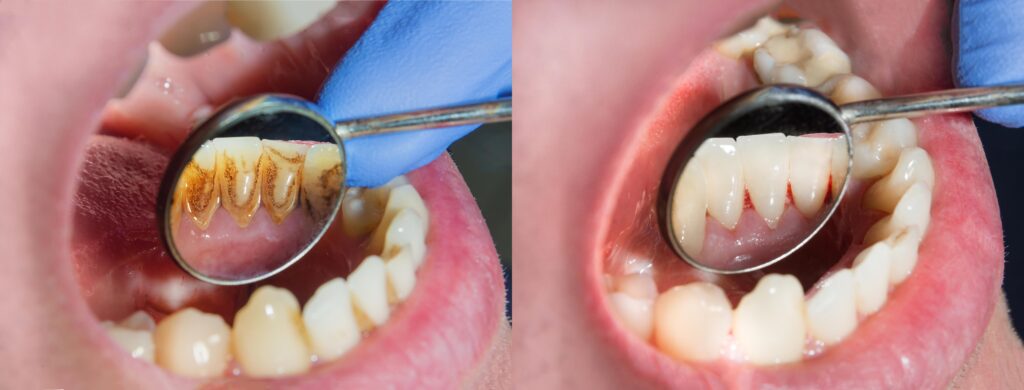
Why you should see a hygienist
While signs of gum disease can be quite obvious, many people experience no symptoms at all. Left untreated, gum irritation can lead to long-term problems, including bone recession and tooth loss.
Combined with a good oral hygiene routine of brushing and flossing twice a day, regular trips to the hygienist in-between dental appointments are the best way of ensuring that your teeth stay healthy and strong. Just as you should visit your dentist twice a year, you should also aim to visit your hygienist every six months, unless directed otherwise.
Dental Hygiene FAQs
What treatments can I get from a hygienist?
Your hygienist offers the following services:
- Professionally deep clean and polish your teeth (otherwise known as scaling and polishing). This helps to remove any plaque build-up, greatly reducing your chances of developing gum disease.
- Point out any ‘problem areas’ and ways in which you can improve them.
- Advise on interdental devices which could improve the health of your teeth and gums.
- Educate patients on their oral health, including tips for keeping their mouth, teeth and gums healthy in the long-term.
- Help keep breath fresh and prevent the development of any gum disease.
- Help prevent the need for more involved treatments in the future.
- Spot the early signs and changes in your mouth that could indicate oral cancer and other dental diseases.
What do I need to know about plaque and tartar?
Plaque is a sticky biofilm that continually forms at the gum line and which must be regularly brushed away; if neglected, sugar and acid in our food and drink reacts with plaque and starts to attack the tooth enamel, ultimately leading to cavities. When plaque isn’t brushed away properly, it hardens into tartar, which makes it even more difficult to clean effectively around the gum line, exacerbating the onset of tooth decay and gum problems.
What do I need to know about interdental brushing?
As a result of improved oral hygiene and fluoride, more people are keeping their own teeth into old age. In order to continue to maintain healthy teeth and gums, a regime of brushing and rinsing twice a day should be combined with interdental brushing – cleaning between the teeth.
The major cause of tooth decay and gum disease is plaque. The formation of plaque is continuous and its growth cannot be stopped. Whilst brushing controls plaque formation around the surfaces of your teeth, it does not reach between your teeth and that’s why interdental brushing once a day is so important.
Cleaning between your teeth is made possible by the use of the following:
- Dental floss
- Interdental brushes
- Single tuft toothbrushes
- Dental sticks
- Rubber tip stimulators
- Irrigation devices
Talk to your dentist or hygienist to learn more about the right method of interdental brushing for you.
How often should I see the hygienist?
Ideally you should visit the hygienist twice a year, though if you’ve had dental implants or dental restorations, your dentist may require you to visit more regularly as your restored teeth may need to be monitored more vigilantly. Have a question? Contact Winchmore Hill Dental Practice for more details.
High-quality family dental care in Enfield, Southgate and North London
From toddlers to implants and dentures, your family’s oral health is our main concern here at Winchmore Hill Dental Practice. We are proud to offer an exceptionally high standard of care when it comes to general dental treatments – and our caring approach extends across our practice, from reception staff to dental nurses, hygienists and dentists.


Check-ups
Check-ups are essential for staying on top of your oral health – and for creating a positive relationship with your dentist that will remain with you and your family for life. Patients who avoid visiting the dentist are far more likely to need to undergo the kind of extensive dental care they fear; but with regular check-ups, your dentist spot and eliminate dental problems before they become more challenging – and costly – to treat.
During your check-up, you will receive a thorough oral examination and your dentist will ask you lots of questions about your teeth and gums, your general health and your lifestyle. If any problems are identified that require treatment, a plan will be drawn up and follow-up appointments booked.

Children
Children’s teeth are just as important as those of adults, so it is important that you bring your child to see us when they’re between the ages of two to three. As well as ruling out any serious problems, visiting the dentist early in childhood establishes a habit that will stay with them for life.
Tooth decay is on the rise among children in the UK – partly thanks to our sugary diet, and partly because parents either avoid coming to the dentist, or believe that it will be expensive to have their children treated.

Fissure sealants
At Winchmore Hill Dental Practice we recommend fissure sealants as an effective way of protecting against cavities. They are ideal for young teeth and permanent molars and pre-molars, once they are mature enough for application. Your dentist may recommend a fissure sealant for adults, too, if they are at high risk of developing cavities.
Fissure sealant FAQs
What is a fissure sealant?
A fissure sealant is effectively a clear, plastic material that is placed onto the surface of your teeth to protect them from bacteria. Sealants are most commonly applied to the molars and pre-molars. Sealants can be applied to any tooth with pits or fissures, provided the surface is sound and it has no previous fillings.
How is the sealant applied?
It is quick, easy and comfortable to apply a fissure sealant. There is no need for an anaesthetic, drills or needles. Your tooth and fissures will be prepared and cleaned before the sealant is applied. Following application, the sealant will be hardened under a special UV light, forming a protective coating over the tooth. Fissure sealants can be applied either by a dentist or dental hygienist.
When should I have a fissure sealant applied?
It is recommended that the sealant is applied as early as possible after the adult teeth have erupted as this offers the best chance of success. It is important to ensure that your tooth enamel is fully matured before applying any sealant. Your dentist can advise you depending on your risks and the condition of your teeth.
How successful are sealants?
It is widely agreed that sealants are highly effective in helping to prevent decay in fissures. Just like a normal filling, a fissure sealant can last for many years with the correct maintenance and care. If the sealant becomes damaged or falls out, it can be easily replaced. Regular dental and hygienist checks are important in order to maintain the condition of your sealants and spot any problems early.